Humanity has always looked to the stars and wondered whether we are alone.
In The Terran Accord: The Awakening, that question is finally answered.
The story begins in a near-future world that is technologically advanced, politically divided, and still recognizably our own. Nations compete for influence. Military power remains central to global security. Humanity has taken important steps beyond Earth, but it is nowhere near becoming a true space-faring civilization.
Then everything changes.
An encounter with an advanced extraterrestrial civilization reveals that humanity is not only part of a much larger universe, but also far less prepared for it than anyone could have imagined.
At the center of that discovery is Gavin Trent, a former U.S. Space Force test pilot whose career and life were shaped by decisions made under extreme circumstances. Gavin is not looking to become the person responsible for humanity’s future. He has already carried more than enough responsibility.
But history rarely asks whether someone is ready.
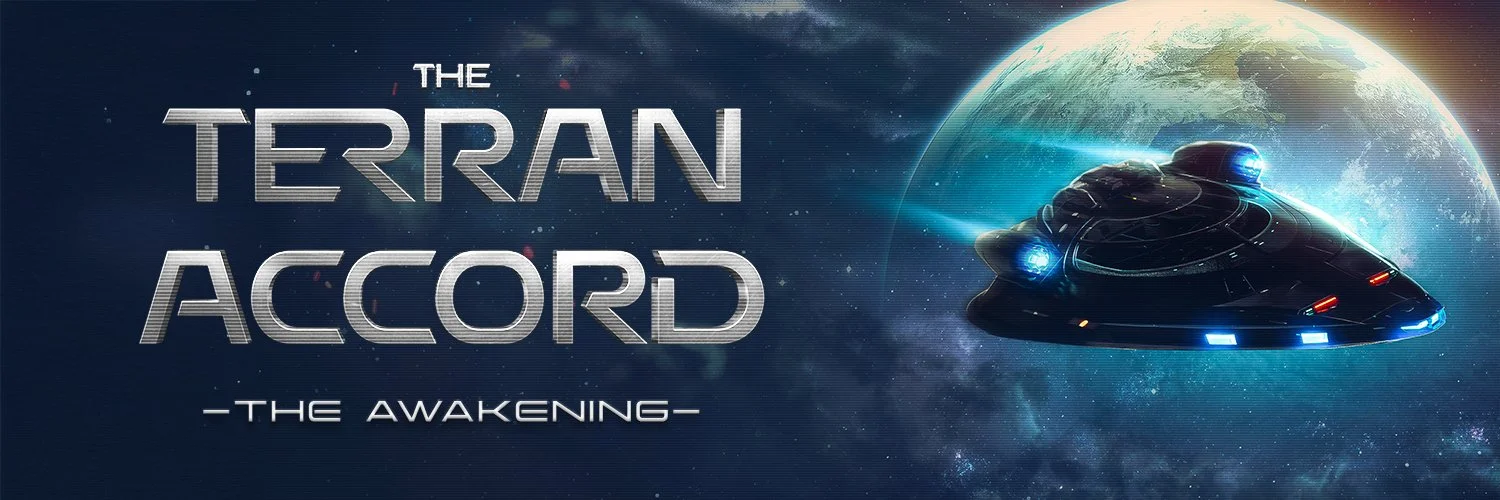
Drawn into humanity’s first contact with the Yalorian, Gavin and a small group of pilots, engineers, physicians, scientists, soldiers, and specialists suddenly find themselves operating technology centuries beyond anything developed on Earth. At the heart of that technology is the Vanguard, an extraordinary spacecraft capable of changing not only humanity’s reach into space, but the balance of power on Earth itself.
That creates a problem more complicated than first contact.
Who should control it?
The Yalorian offer knowledge and capabilities that could transform medicine, energy, transportation, communications, and spaceflight. But every technological gift creates consequences. Governments see strategic advantage. Military leaders see capabilities that could alter deterrence forever. Scientists see discoveries that could redefine humanity’s understanding of physics. Ordinary people see both extraordinary opportunity and reasons to be afraid.
And the crew of the Vanguard quickly learns that having access to advanced technology is not the same as knowing how to use it responsibly.
That question lies at the center of The Awakening.
The novel is not simply about what happens when aliens arrive. It is about what happens next.
How would governments react if another civilization suddenly appeared and offered humanity technologies far beyond anything we possess?
Would nations cooperate, or would they compete to gain control of those technologies?
Could existing political institutions adapt quickly enough?
What would happen if a handful of people found themselves responsible for capabilities powerful enough to change the world before the world had decided what rules should govern them?
Those questions become even more urgent when humanity discovers that first contact is not the greatest threat it faces.
A massive object designated K-101—later known as Cirratus—is approaching Earth.
Its trajectory leaves little doubt about what will happen if nothing is done.
Suddenly, political disagreements, national rivalries, and arguments over control collide with a problem that does not care about borders.
Stopping Cirratus will require technology humanity barely understands, cooperation between people who do not necessarily trust one another, and decisions that may determine whether billions of people survive.
For Gavin and the crew of the Vanguard, the challenge becomes more than finding a technological solution. They must learn how to operate as a team while carrying responsibilities for which there is no precedent. Mistakes carry enormous consequences. Success requires sacrifice. And every decision forces them to confront a larger question: what kind of civilization does humanity want to become?
The Yalorian can provide knowledge.
They can provide technology.
They can even offer guidance.
But they cannot make humanity’s choices for it.
That burden remains human.
The Terran Accord: The Awakening combines first-contact science fiction, political tension, advanced technology, spaceflight, and planetary-scale stakes with a story grounded in the people caught inside those events. Its characters are pilots, engineers, physicians, scientists, diplomats, soldiers, and leaders—people forced to make consequential decisions with imperfect information and very little time.
They disagree.
They make mistakes.
They carry old wounds and beliefs, as well as personal loyalties into circumstances no one has ever faced before.
And gradually, they begin to understand that humanity’s greatest challenge may not be surviving first contact or even stopping an approaching catastrophe.
It may be learning to think beyond the boundaries that have defined human civilization for centuries.
Because once humanity knows it is not alone, there is no returning to the world that existed before.
The stars are no longer distant points of light.
They are destinations.
Other civilizations are no longer speculation.
They are neighbors.
And the technologies that once belonged only to science fiction are suddenly real—and in human hands.
The Awakening is the first novel in The Terran Accord, a series about humanity’s transition from a divided planetary civilization to something larger. It begins with discovery, but the larger story is about responsibility: how quickly humanity can adapt when technological capability races ahead of political institutions, cultural assumptions, and human judgment.
For Gavin Trent and the crew of the Vanguard, first contact is only the beginning.
Humanity has awakened to a larger universe.
Now it must decide what to do with that knowledge.